The 2026 Dallas County Economic Mobility Report


For 15 years, The Commit Partnership has worked from a simple premise: meaningful improvements in economic mobility don't come from any single program, institution, or policy. They come when the systems surrounding young people—early childhood, pre-K–12 education, higher education, workforce, public policy, philanthropy, and community support—work toward shared outcomes and are held accountable by common data.
The newly released 2026 Dallas County Economic Mobility Report is Commit's 15-year checkpoint on that belief. Both Chairman & CEO Todd Williams and Dallas County Impact President Miguel Solis are direct in their welcome letters about what's working and what isn't.
Todd shares: "When we began this work, our region did not lack people who cared deeply about public education. Nor did we lack programs, investment, or good ideas. What we lacked was alignment and a strong focus on changing systems to produce better outcomes. Today, that belief is showing up in results."
Here's what our report actually found:
The big picture in Dallas County
Dallas County's public education systems serve nearly 450,000 students—about 8% of all public school students in Texas. Over the past 15 years:
- more children have been accessing pre-K
- academic performance has improved across several key measures
- more students have graduated prepared for college and careers
- young adult poverty has declined
- employment remains strong
- a greater share of Dallas County residents ages 25–34 is earning a living wage
But the central challenge remains: In 2024, just 32% of Dallas County young adults earned the ~$62,400 living wage required to support themselves and their families. And that opportunity remains unevenly distributed by race, place, and socioeconomic status.
Four years into Opportunity 2040
Launched in 2022 by Commit and the Child Poverty Action Lab, Opportunity 2040 is an 18-year, $370 million catalytic philanthropy investment plan designed to place 150,000 more Dallas County students on a path to economic mobility and cut child poverty in half—while unlocking an estimated $7.1 billion in potential return through increased access to, and more effective use of, public funding.
Four years in, the results are ahead of schedule:
47,558 more students are now meeting critical benchmarks.
Success is seen across Opportunity 2040's 11 indicator tracks.
Results not only exceed the plan's five-year goal of 39,087 by 21% but also are a year early.
Conservatively assuming those students go on to earn only an associate degree or industry credential, national research suggests they'll earn an average of $597,000 more over their lifetimes than they would with only a high school diploma—more than $28 billion in additional lifetime earnings for the region.
The state of economic mobility in Dallas County
The report's headline chart tracks the two numbers Opportunity 2040 exists to move: living-wage attainment and youth poverty among Dallas County young adults ages 25–34, since 2012.
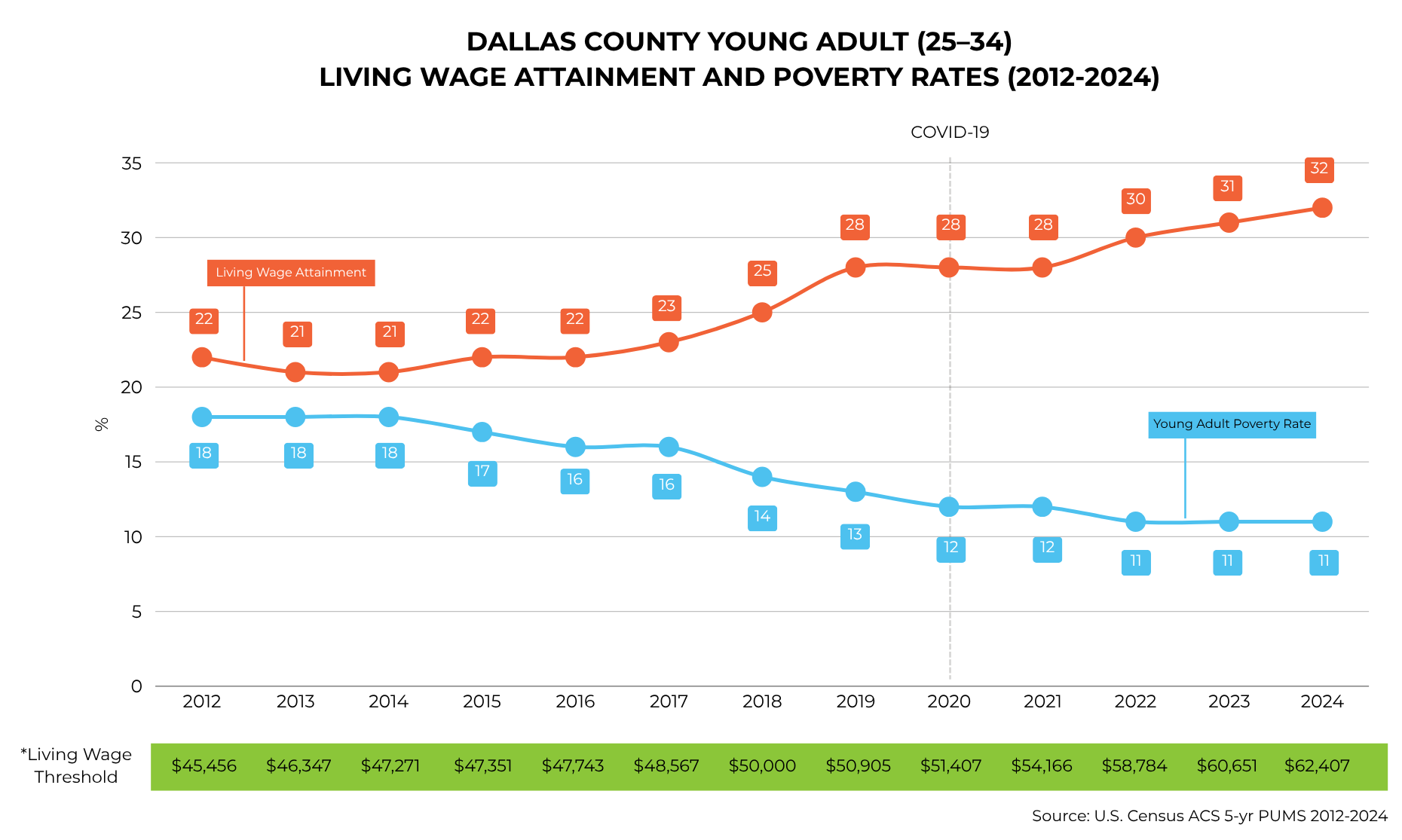
Living-wage attainment has climbed steadily, from 22% in 2012 to 32% in 2024, even as the living-wage threshold itself rose with inflation, from $45,456 to $62,407. Over the same period, young adult poverty fell from 18% to 11%, essentially flat for the past three years after a sharp pandemic-era drop. The takeaway, according to the report: "Progress is real, but it is not yet fast enough."
Where progress is accelerating
The strongest signal in this year's report is in the classroom. Dallas County students improved three percentage points across tested grades and subjects in grades 3–8, and seven points across the five high school End-of-Course assessments—outpacing statewide growth in both cases. Algebra I proficiency alone increased eight percentage points in a single year, and Biology rose 12 points.
Sixty percent of Dallas County campuses earned an A or B accountability rating in 2026, up from 58% in 2025, while the share rated D or F fell from 16% to 14%.
Most striking: 40 Dallas County campuses rated D or F in 2023 climbed to an A or B by 2026.
Middle schools—historically one of the hardest points in the pipeline—posted some of the strongest gains, with 60% earning an A or B, a 14-point jump from the prior year.
Garland ISD offers one concrete example of what's driving this: after asking what it would take to make college-level coursework available to every student who wanted it, the district embedded Early College and P-TECH programs across all seven of its comprehensive high schools. Dual-credit participation grew from 3,580 students earning 130 college credentials in 2020–21 to 5,348 students earning 721 credentials—including 469 associate degrees—by 2024–25, saving families nearly $3.9 million in college costs.
Progress remains uneven
Regional averages tell only part of the story. Race, family income, and geography continue to shape educational and economic outcomes across Dallas County—and with students of color comprising the majority of enrollment districtwide, closing these gaps is central to reaching the county's goal.
In the latest data, 52% of White young adults and 49% of Asian young adults in Dallas County earn a living wage, compared with 22% of Black young adults and just 18% of Hispanic young adults. All four groups have improved since 2012—Hispanic attainment has doubled, from 9% to 18%—but the gaps between groups have not meaningfully closed.
Economically disadvantaged students are also more than twice as likely as their higher-income peers to attend a D- or F-rated campus.
The full pipeline: from pre-K to a living wage
The report's clearest illustration of the work ahead is a single chart comparing 2012 baseline performance to today across every milestone on the path to a living wage.
Nearly every indicator has improved—pre-K enrollment (32% to 53%), third-grade reading (35% to 45%), Algebra I (33% to 52%), college readiness (22% to 67%), and high school graduation (84% to 89%) among them.
But the chart above also shows where the pipeline leaks: postsecondary enrollment actually declined slightly (62% to 55%) even as readiness surged, and postsecondary completion moved only modestly (30% to 34%).
As the report puts it, "readiness changes a life only when a student can enroll, persist, complete a credential, and enter a career that pays a living wage." That's why Commit identifies postsecondary success—not K-12 academics alone—as the most important lever left to pull.
Policy, funding, and systems change
Much of this progress traces to specific investments the region chose to make and follow through on. The Teacher Incentive Allotment (TIA), a compensation model piloted in Dallas ISD and later adopted statewide through House Bill 3, is now paying effective teachers more to work in the classrooms and campuses that need them most—with designated teachers seeing average annual raises exceeding $11,000.
Texas' 89th Legislature built on that with House Bill 2, which provided $8.5 billion in new public education funding—the largest increase in state history—including $3.5 billion for teacher compensation, $448 million for early learning, and $153 million for career and technical education, while expanding TIA eligibility to up to half of teachers statewide.
Locally, voters have approved 15 bond and tax ratification elections across the region since 2020, including Dallas ISD's $6.2 billion bond—the second-largest in U.S. history—along with Richardson ISD's $1.4 billion bond and Lancaster ISD's $376 million bond, all aimed at modernizing facilities and expanding career and technical education.
Dallas County Promise, meanwhile, has grown from a scholarship program reaching 9,000 students in 2017 into a coordinated system now supporting more than 110,000 students a year toward a postsecondary credential and a living-wage career.
What a living wage changes
The report grounds its data in a single story: Karla Garcia, whose Dallas ISD principal personally intervened to help her transfer to a selective high school, setting off a chain of advising and financial-aid support that carried her to the University of North Carolina despite a $38,000 funding gap. Garcia—the daughter of immigrant parents who worked in construction and fast food—went on to become the first Latina elected to the Dallas ISD Board of Trustees.
Her story, the report notes, "captures the essence of Commit's True North goal: not simply creating opportunity, but building a system that helps students see it, reach it, and turn it into a different life."
The road ahead
Both Todd and Miguel close their letters with the same caution: 15 years of progress is not the same as arriving.
"Too many children still enter school without the preparation they need," Todd writes. "Too many students who successfully graduate from high school never enroll in postsecondary education—or begin but do not complete a credential. And despite years of steady improvement, fewer than one in three young adults in Dallas County currently earn a living wage."
Miguel framed the task ahead as one of intensity, not reinvention:
"We need to protect the gains happening in classrooms. We need to strengthen the places where students are still being lost—especially the transitions from high school to postsecondary education. We need to accelerate the capacity of the institutions doing this work. And we need to confront the opportunity gaps that still determine which students benefit from progress and which do not."
The complete 2026 Dallas County Economic Mobility Report is available here.
For a recap of how Commit marked this 15-year milestone—including the full list of 2026 Dallas County Economic Mobility Summit award winners—see our Latest Learnings blog post on the Summit here.
__________
Frequently Asked Questions
What is the 2026 Dallas County Economic Mobility Report?
It's The Commit Partnership's annual data report tracking whether Dallas County's education and workforce systems are translating into real economic opportunity for young people, marking 15 years of the Partnership's work in 2026.
What percentage of Dallas County young adults earn a living wage?
As of 2024, data cited in the 2026 report show that 32% of Dallas County young adults ages 25–34 earn a living wage, up from 22% in 2012. The current living-wage threshold is approximately $62,407.
What is Opportunity 2040?
Opportunity 2040 is an 18-year community investment plan launched in 2022 by Commit and the Child Poverty Action Lab to place 150,000 more Dallas County students on a path to economic mobility and cut child poverty in half by 2040.
How many students are now on a path to economic mobility because of Opportunity 2040?
As of the 2026 report, 47,558 more Dallas County students are meeting Opportunity 2040's critical benchmarks than in 2022—21% ahead of the plan's five-year goal, achieved a year early.
What is Commit's True North goal?
By 2040, at least half of all Dallas County residents ages 25–34, irrespective of race, will earn a living wage.
Do living-wage attainment gaps exist by race in Dallas County?
Yes. As of 2024, 52% of white young adults and 49% of Asian young adults earn a living wage in Dallas County, compared with 22% of Black young adults and 18% of Hispanic young adults.
What academic gains does the 2026 report highlight?
Dallas County students improved three percentage points across grades 3–8 and seven points across high school End-of-Course exams in 2026. Algebra I proficiency rose eight percentage points in a single year, and 60% of county campuses earned an A or B accountability rating.
Where is Dallas County falling short of its economic mobility goals?
The report identifies postsecondary enrollment and completion as the weakest links: postsecondary enrollment remains below 2022 levels, and while nearly 17,000 more students are college-ready, only about 1,400 more have enrolled and fewer than 200 more have completed a credential.
Who leads The Commit Partnership?
Todd Williams is the founder, chairman, and CEO. Miguel Solis is president of Dallas County Impact.
Where can I read the full 2026 Dallas County Economic Mobility Report?
You can find the complete 2026 Dallas County Economic Mobility Report here.
Latest Learnings


Be a part of the impact



.avif)


